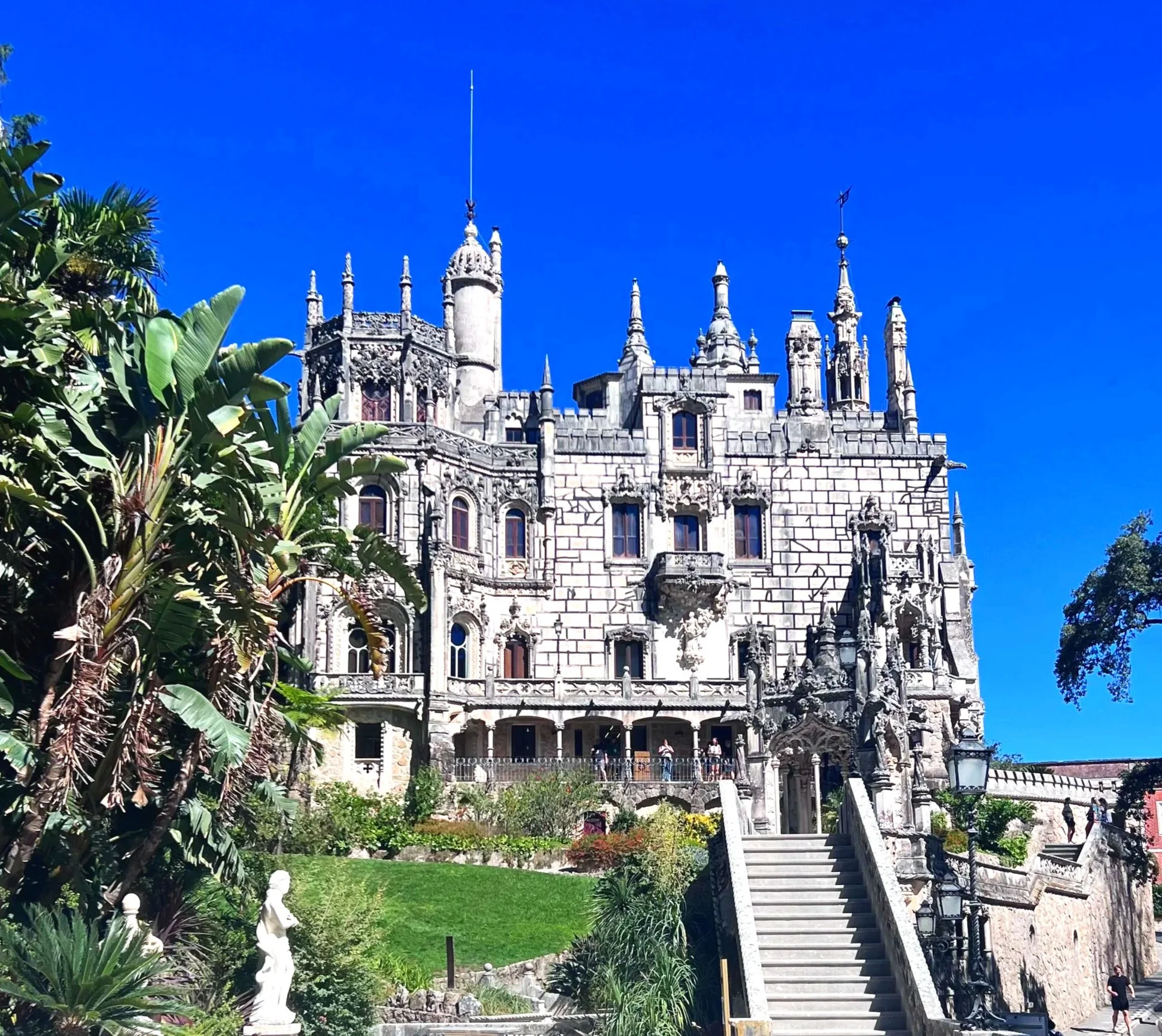
Palace of the Monteiro Millionaire at Quinta da Regaliera, Sintra
The Initiation Wells of Quinta da Regaleira
Under an hour from the bustling streets of Lisbon, nestled in the lush hills of Sintra, lie the fairy-tale-esque gardens and palace of Quinta da Regaleira. This UNESCO World Heritage Site is filled with hidden grottos, ornate fountains, towers, lakes and winding underground tunnels. But there is more to this site than its beautiful scenery. Much like a stage set, Quinta da Regaleira’s eclectic styles are filled with symbolism and mystery, taking visitors on a spiritual journey as they wander the grounds of this enchanting site.
The estate as we see it today was created by António Augusto Carvalho Monteiro, one of Portugal’s wealthiest men at the turn of the 20th century. From 1904 to 1910, he worked alongside the Italian architect and theatre set designer Luigi Manini to transform the grounds into something truly magical, weaving together Christian symbolism, pagan traditions and references to secret societies galore.
One of the most intriguing places within Quinta da Regaleira is the inverted tower named The Initiation Well, where a doorway opens onto a steep spiral staircase that winds down through nine levels and leads out into a network of underground passages and grottos. At the bottom of the well, carved into the floor, lies an eight-pointed cross bearing the emblem of the Portuguese Order of Christ, the order that replaced the Knights Templar in Portugal. Whether the nine levels represent the nine founding members of the Knights Templar, or the nine circles of Dante’s Hell, the experience of descending the well is one to remember.
The Initiation Well gets its name as it was rumoured to be used in the inauguration ceremonies that took place at the property, where new members would descend the winding staircase carrying a sword held against their chest before making their way through the dark tunnels and passageways and emerging into the light. A spiritual journey said to symbolise death and rebirth, where initiates are reborn and welcomed into the brotherhood by the awaiting members at the end of the tunnel.
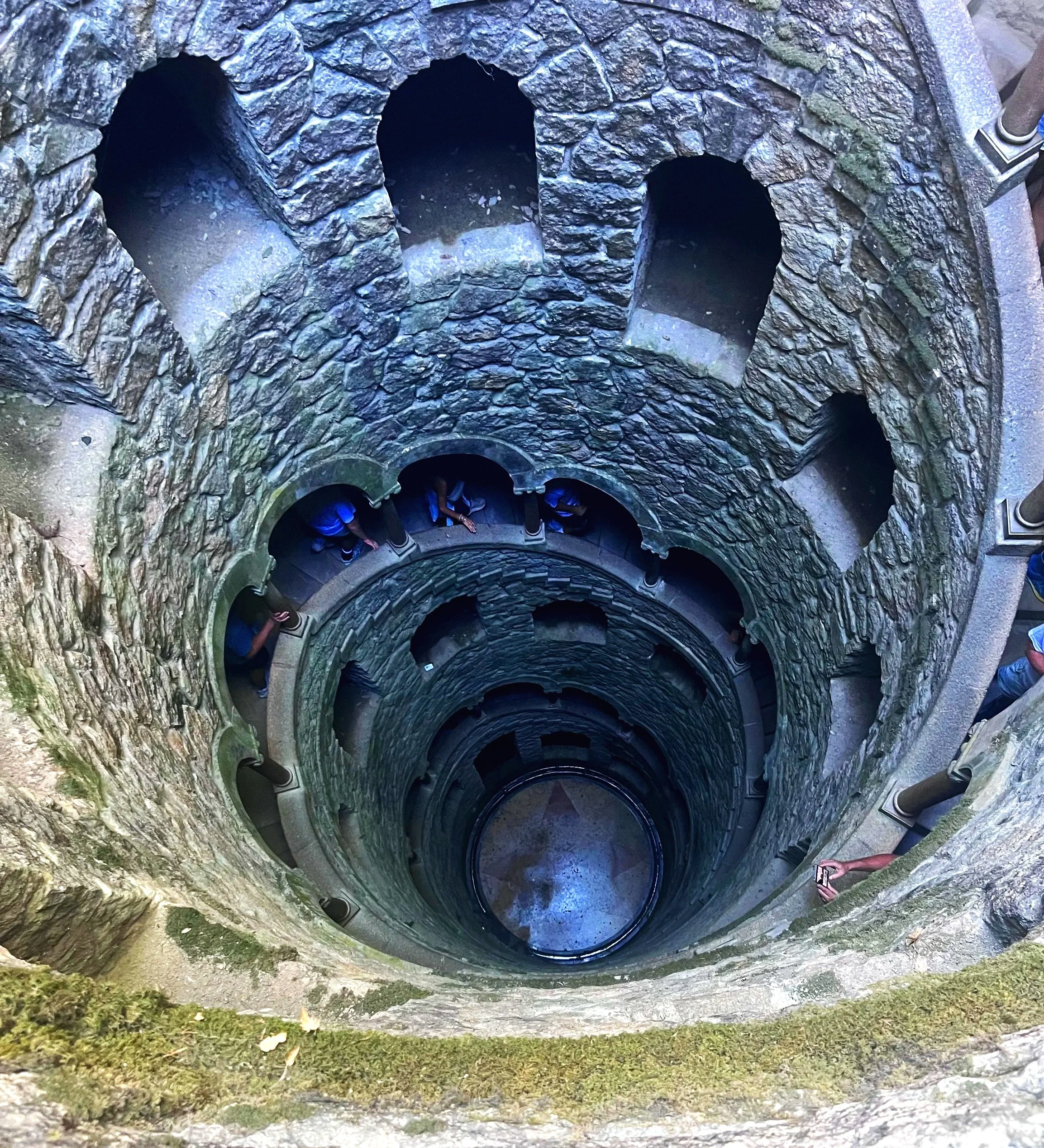
The Initiation Well at Quinta da Regaliera, Sintra
The Knights Templar and Order of Christ
Quinta da Regaleira's symbolism for secret societies runs deep, and none is as famous or as revered as the Knights Templar, one of Europe's earliest secret societies. Known for the Holy Grail and the Ark of the Covenant, this group remains one of history's most mysterious secret orders. The Knights Templar started as a small group of French monks who banded together in 1119 with the aim of protecting pilgrims on their journey to the Holy Land, but this small group quickly grew into a powerful and wealthy military organisation. Owning vast lands and fortresses and wearing their trademark white tunic marked with a red cross, they accumulated power, wealth, and influence across Europe.
Unfortunately, due to this power, wealth, and influence, on Friday, 13 October 1307, King Philip IV of France set out to destroy the order and seize their assets, arresting its members throughout the country and putting them on trial for heresy. By 1312, Pope Clement V had formally dissolved the order, which was followed by the execution of its last Grand Master, Jacques de Molay, who in 1314 was burned at the stake in Paris as a heretic. However, back in Portugal, with the help of King Denis I, the Knights quietly changed their name from the Knights Templar to the Order of Christ. This new organisation, with all the assets of the Templars and wearing the red cross tunic, helped Portugal become a power on the seas, aiding the country's maritime expansion throughout the world.
However, it wasn't just wealth and military strength that the Knights Templar and the Order of Christ were known for; they were also pioneers in medieval medicine, blending both traditional European medical knowledge with that gained from the Islamic world through the Crusades. They were known for using antiseptic techniques and promoted hand-washing, unheard of in those days. They were skilled in surgery with procedures such as amputations, and had dedicated field staff able to treat injured soldiers on the battlefield. They also had medicinal knowledge at their disposal, using herbs with bactericidal and fungicidal properties to treat the injured, and poppy seeds and willow bark (modern-day opiates and aspirin) to alleviate the suffering of the wounded.
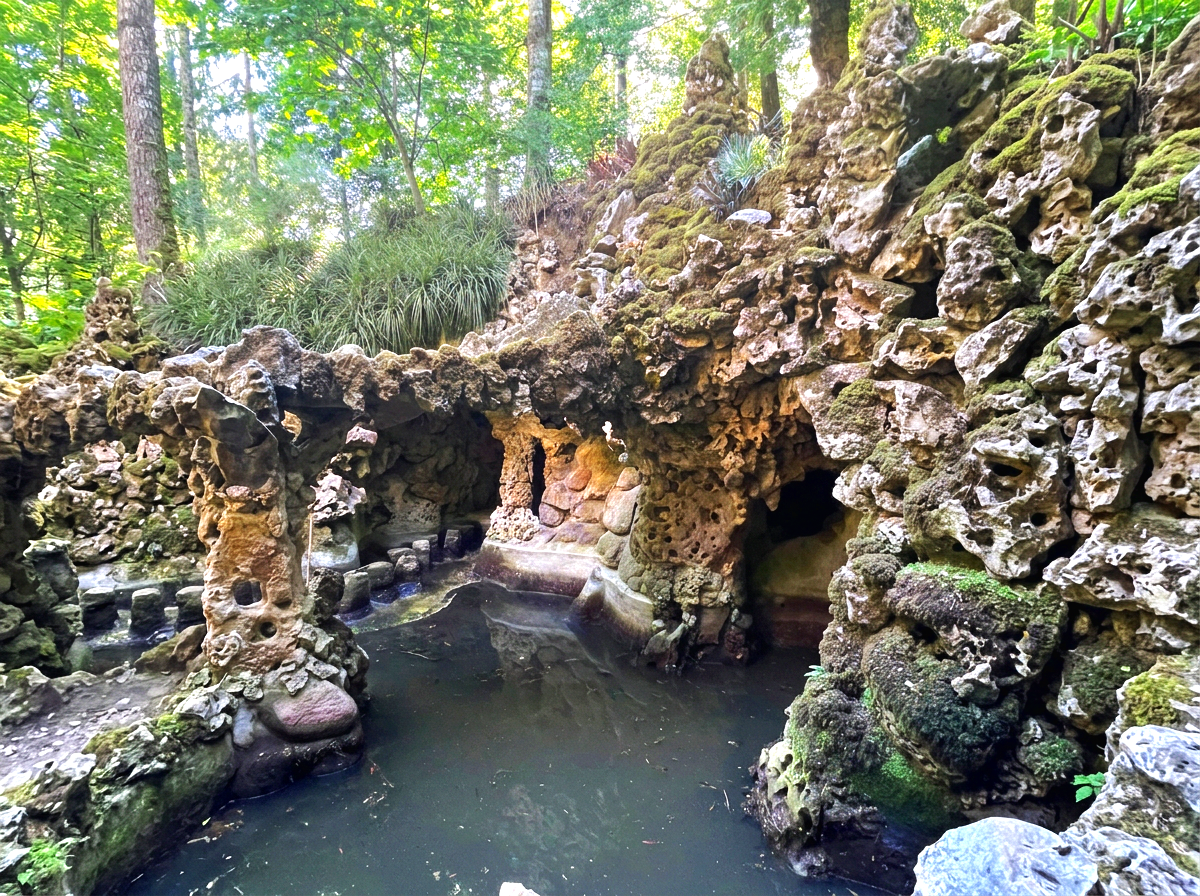
The Labyrinth Grotto at Quinta da Regaliera
Top Tips
Getting there: Sintra can easily be reached from Lisbon in under an hour. Private car, taxi, train, or organised tour are all options. If opting for the train from Lisbon, head to Rossio Station for the Lisbon-Sintra coastal train that departs every 20-30 minutes, taking approximately 40 minutes to reach the final stop named Sintra Station (not the second-to-last Portela de Sintra stop). Tickets can be purchased easily from the automatic machines before boarding and cost about 5 euros return. The old town of Sintra is a 10-15 minute walk from the station.
Parking: Driving is difficult and heavily restricted in Sintra as the roads are narrow, congested, and mostly one-way. If parking at a central hotel, they will give you a permit to enter the area, but there are free large public car parks on the outskirts, within walking distance of the main sights, which are a far easier and less stressful option.
Getting around: Sintra’s historic centre is best explored on foot as it is quite compact with many small shops and restaurants. Quinta Regaleira and Pena Palace can easily be visited on the same day along with the town centre; however, Pena Palace involves about an hour's walk uphill. There are also tuk-tuks, taxis, and a bus option if this is too much. The Villa Sassetti Path is a lovely uphill, though steep, walk that goes through lush forests, while the gentler route via the Santa Maria path is worth considering for the descent. Make sure to wear comfortable walking shoes and bring plenty of water. The walks are not appropriate for pushchairs or those with limited mobility.
Tickets: Book your tickets online in advance, particularly during peak season, as entry can sell out. Make sure to arrive at your allocated time slot; otherwise, you will be refused entry. Tickets can be purchased in advance at https://regaleira.byblueticket.pt/ and cost 20 euros per adult, 15 Euros for seniors (65+), and youths (6-17), and are free for 5 and under.
Facilities: A free map is given at the ticket gate, handy for navigating the gardens and finding the hidden tunnels, grottoes and wells. Allow around two hours to explore the estate at a leisurely pace. There are toilets on site, a café and a small gift shop at the end.